
Information
-
The US-India Trust Conference, taking place on May 11, 2026, brings together eight academics contributing to a forthcoming book edited by Dr. Šumit Ganguly, Senior Fellow at the Hoover Institution. Spanning India’s independence in 1947 to contemporary issues, the chapters examine key interactions between leaders, pivotal events, and the themes of trust and mistrust in US-India relations across different decades.
This private conference will convene the contributors and invited scholars from Hoover and Stanford University to discuss the submitted chapters, explore current developments, and engage in in-depth conversations about trust in US-India relations.
The conference is a full-day, in-person event, running from 8:30 AM to 4:00 PM at the Hoover Institution, Stanford University.
The event is private, with attendance by invitation only.
-
Slides: Slide decks are welcome and should be submitted to Jane Leakey (jleakey@stanford.edu) by Sunday, May 10, at 12:00 PM.
Travel: If you are traveling to Stanford University for the conference, please send your economy-class flight receipt to Jane Leakey (jleakey@stanford.edu) so that we can promptly reimburse you after the conference.
Accommodations: Your accommodations are being arranged on your behalf at the Sheraton Palo Alto Hotel. Check-in is at 3:00 PM, and check-out is at 11:00 AM.
Ground Transportation: We can reimburse up to $200 for ground transportation expenses (Uber, Lyft, taxi, etc.). Please collect your receipts and send them to Jane Leakey (jleakey@stanford.edu).
Reimbursements: All reimbursements will be processed promptly after the conference upon submission of receipts.
-
A commentator in a session provides expert perspective on the presentations and chapters, highlighting key points, offering insights or constructive critique, and connecting the discussion to broader themes. They help guide the conversation, raise questions, and stimulate dialogue among presenters and the audience, ensuring the session remains engaging and focused.
Commentators should read the chapter for their session in advance; the chapters can be found here.
Commentators do not need to stay for the entire day—they may attend only the session they are commenting on, though they are welcome to stay for the full conference if they wish.
-
Attendance: If you have been invited to attend the conference as an audience member, you may attend all sessions or select sessions depending on your availability. If you can only attend part of the conference, please RSVP and inform our team of your availability so we can plan accordingly, especially for meals and logistics.
Chapters: Audience members are welcome to review the chapter drafts for this book project. As the work is still in progress, please treat the drafts and any insights as confidential and avoid sharing them broadly.
-
Each session will be 1 hour and 15 minutes long.
Presenters will have 20 minutes to share their research (slide decks are permitted).
The remainder of the session will be reserved for the commentator to provide remarks, pose questions to the presenters, and allow time for Q&A with the entire audience.
Note: Time allocations may be adjusted slightly depending on discussion flow. A timer will be available in the room to assist with time management.
-
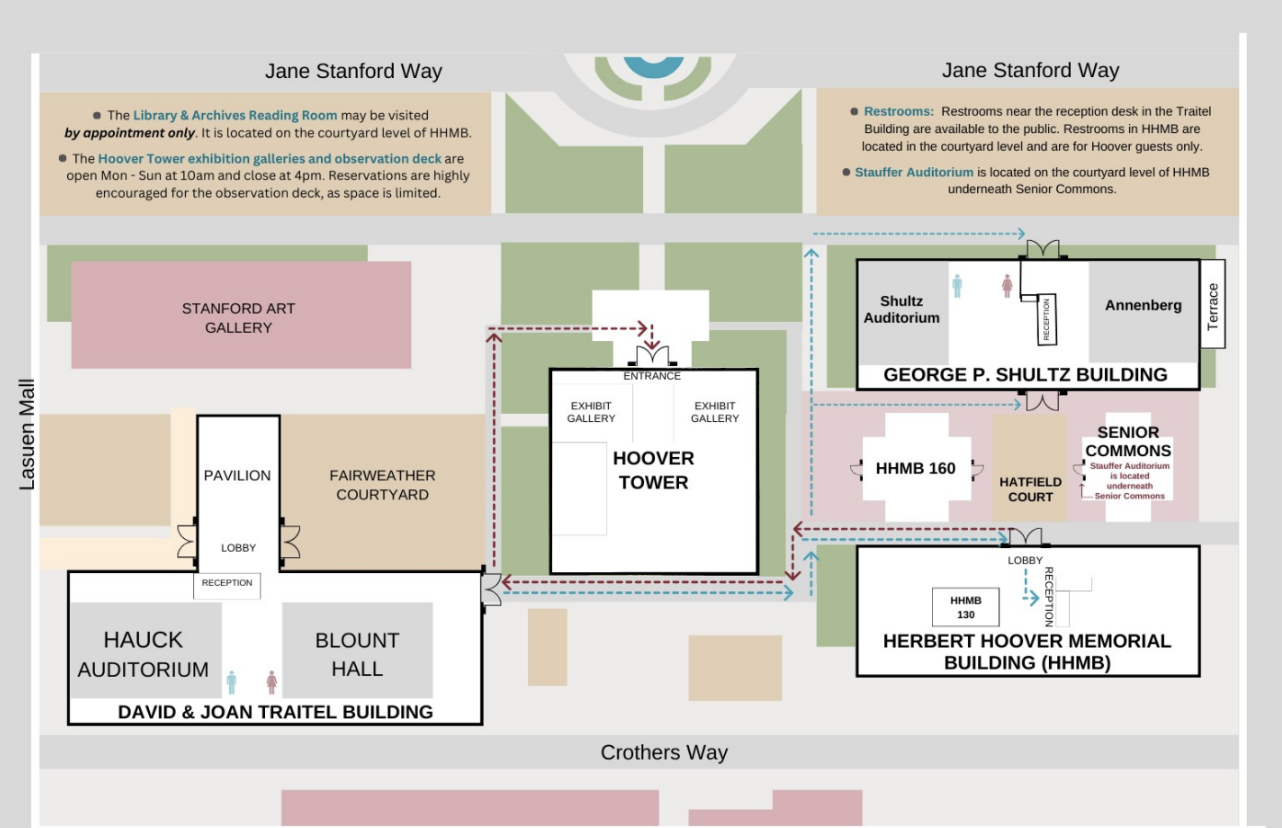
The US-India Trust Conference is taking place in room 408 of the George P. Shultz Building at the Hoover Institution.
Map of the Hoover Institution:
-
If you plan to drive to the conference, visitor parking is available in designated areas throughout the Stanford campus. Visitors must pay for parking using the ParkMobile system—either through the app, by phone, or as a guest—with daily and hourly options available in visitor zones. Make sure to check the posted signs and enter the correct zone number when you pay.
More details on where to park and how to pay can be found on Stanford Transportation’s parking page: https://transportation.stanford.edu/parking-stanford
-
Public Event: Powering Global Cooperation:
Innovation, Security, & Geopolitics in a Changing Energy LandscapeIn today’s world, energy is a driver of security, prosperity, and strategic influence. As geopolitical shocks, market volatility, and technological change transform the global energy landscape, trusted partnerships are becoming essential to resilience and long-term stability.
Join Condoleezza Rice and Arun Majumdar, in conversation moderated by Šumit Ganguly, on how energy is reshaping international cooperation. Drawing on lessons from the U.S.-India Civil Nuclear Accord and the challenges of today’s security environment, the discussion will explore how the United States and its partners can strengthen energy security, advance innovation, and build a more stable global future.
This timely discussion will examine the intersection of energy, trust, and geopolitics—and what it will take to power cooperation in a rapidly changing world.
Opening Remarks: Ambassador David C. Mulford, Distinguished Visiting Fellow, Hoover Institution, and former US Ambassador to India (2004-2009)
Dr. Condoleezza Rice, Tad and Dianne Taube Director of the Hoover Institution and the Thomas and Barbara Stephenson Senior Fellow on Public Policy
Dr. Arun Majumdar, Senior Fellow (courtesy), Hoover Institution, Inaugural Dean of the Stanford Doerr School of Sustainability, and the Jay Precourt Provostial Chair Professor at Stanford University
Moderator: Dr. Šumit Ganguly, Senior Fellow, Hoover Institution
This panel is not part of the US–India Trust Conference, but conference participants are encouraged to attend, as the topic complements the themes of the conference and provides valuable insight.
A reception will follow the panel discussion, to which all guests are warmly invited to attend.
If you have not yet registered for this panel discussion, please do so here.